
Does Chocolate Cause Acne? What the Research Actually Shows

"Does chocolate cause acne?" is one of the most commonly asked food-skin questions — and one where the popular answer ("it's probably the sugar and dairy, not the chocolate itself") turns out to be incomplete.
The research here is more interesting than most summaries suggest. There is genuine clinical evidence that chocolate specifically — not just its sugar or dairy content — may worsen acne in susceptible individuals, and the mechanism is more specific than general "inflammation." Here's what the evidence actually shows.
Does chocolate cause acne?
Chocolate doesn't directly cause acne — but it may contribute to breakouts in some people, and whether it does depends considerably on which chocolate and through which mechanism. The "chocolate causes acne" claim has been called a myth so often that the more accurate picture has been obscured: the connection is real, but the culprit in most commercial chocolate isn't cocoa — it's the dairy content elevating IGF-1, the sugar content activating mTORC1, and the high glycaemic load driving the same insulin-androgen pathway covered in the low-GI diet article in this series. Pure cocoa itself contains flavanols that inhibit NF-κB inflammatory activity and may provide modest anti-inflammatory benefit — which is why dark chocolate with high cocoa content and low added sugar occupies a genuinely different position in the acne conversation than a milk chocolate bar, rather than simply being a "healthier" version of the same trigger.
The research: why chocolate specifically is worth attention
For decades, the received wisdom was that the chocolate-acne connection was a myth — perpetuated by early 20th-century dietary beliefs without solid evidence. A 1969 study that found no link between chocolate and acne became widely cited as definitive. That study has since been extensively criticised for significant methodological flaws, including using chocolate bars with very low actual cocoa content.
More recent research tells a different story.
A 2011 pilot study published in the International Journal of Dermatology gave acne-prone young men capsules containing either 100% pure cocoa or a matched placebo. Within one week, the group consuming cocoa showed significantly more acne lesions than the placebo group. Critically, this was pure cocoa — no sugar, no dairy.
A 2014 double-blind, controlled trial published in the Journal of the American Academy of Dermatology used a similar approach — cocoa versus a non-cocoa control — and found that cocoa consumption produced significantly greater increases in acne lesion counts compared to control.
These studies are small and require replication before being considered definitive. But they are controlled trials specifically designed to isolate cocoa's effect — and they found one.
The proposed mechanism: IGF-1 and immune activation
The specific mechanism by which cocoa may worsen acne isn't fully established, but the leading hypothesis involves IGF-1 (insulin-like growth factor 1) and immune signalling.
Cocoa flavanols and other compounds in chocolate appear to stimulate IGF-1 release. IGF-1 is one of the primary hormonal drivers of acne — it promotes sebum production, increases follicular keratinisation (the skin cell buildup that blocks pores), and stimulates androgen activity in sebaceous glands. This is the same pathway through which dairy is thought to worsen acne — dairy contains IGF-1 directly and stimulates endogenous production.
Some research also suggests cocoa stimulates the production of inflammatory cytokines including IL-1β and PGE2 in immune cells — consistent with the inflammatory component of acne.
If this mechanism is correct, it would explain why dark chocolate — despite lower sugar and no dairy — may still affect acne-prone skin for some people.
Dark chocolate: genuinely better, but not entirely safe
For those for whom chocolate is a personal trigger, dark chocolate (70%+ cocoa, minimal added sugar, no dairy) is lower risk than milk chocolate on the glycaemic and dairy dimensions. But it is not entirely without risk on the cocoa-specific dimension identified in the recent trials.
The flavanols and polyphenols in dark chocolate do have genuine antioxidant properties and other health benefits. Dark chocolate is also a good source of magnesium — relevant to stress regulation, which is itself an acne trigger. This is one of those genuinely complex areas where the nutritional benefits and potential acne-worsening effects sit alongside each other, and individual response matters more than any blanket recommendation.
Recommended Products
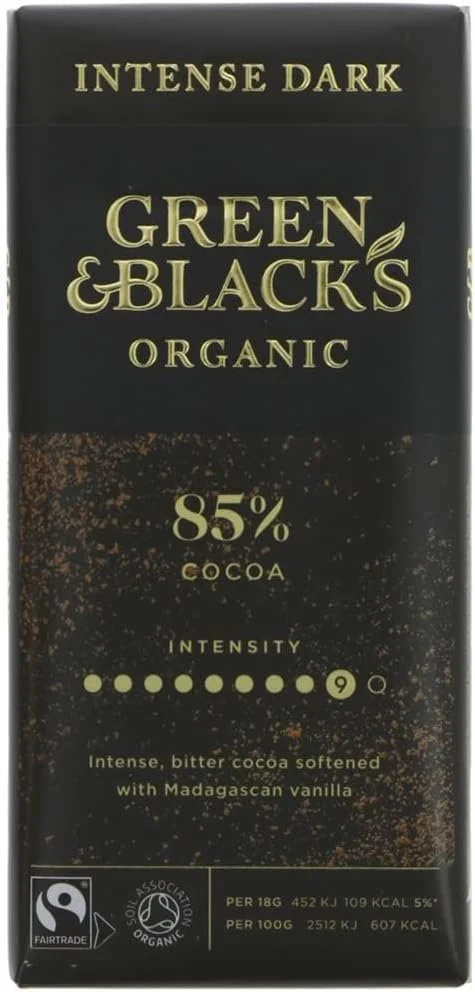
Green & Black's Organic Dark Chocolate 85% Cocoa
an 85% cocoa dark chocolate with minimal added sugar and no dairy — lower risk on the glycaemic and dairy dimensions identified in the research. If chocolate is a regular part of your diet and you're monitoring its effect on your skin, this is the format the evidence most supports over milk chocolate. Note: the controlled trials suggest pure cocoa may still affect acne in susceptible individuals regardless of format — this is a lower-risk option, not a risk-free one.
The glycaemic index argument: still relevant but not the whole story
The original article's focus on sugar and glycaemia is not wrong — high-glycaemic diets are associated with worse acne through their effects on insulin and IGF-1 — but it's incomplete.
High-sugar milk chocolate has a high glycaemic load, which elevates insulin and stimulates IGF-1 — both pro-acne. This is a genuine and well-evidenced mechanism.
But pure dark chocolate with 70%+ cocoa and minimal sugar has a low glycaemic index — and the 2011 and 2014 studies suggest it can still worsen acne. The cocoa itself appears to be doing something independent of sugar content.
Dairy in milk chocolate: also relevant
Dairy is one of the most consistent dietary acne triggers identified in the research literature. The proposed mechanisms involve dairy's IGF-1 content (particularly whey) and its stimulation of the mTORC1 pathway — a cellular signalling pathway that promotes sebaceous gland activity.
Milk chocolate contains significant amounts of dairy. For people whose acne is dairy-sensitive, milk chocolate is a double hit: high glycaemic load plus dairy-driven IGF-1 stimulation.
What this means in practice
The honest answer to "does chocolate cause acne?" is: it depends on your individual sensitivity, the type of chocolate, and your baseline acne activity — but there is genuine evidence that cocoa specifically may worsen acne in susceptible people, independent of sugar and dairy content.
For people whose acne is well-controlled and who eat chocolate occasionally, the evidence doesn't suggest a need for strict elimination. For people with persistent or moderate acne who suspect food is a contributing factor, chocolate — including dark chocolate — is a reasonable thing to eliminate for four to six weeks as part of an elimination and reintroduction approach, to assess whether it's a personal trigger.
If you eliminate chocolate and notice no change, the evidence suggests it's not a significant driver for your acne specifically. If you notice a clear pattern — breakouts appearing within two to four days of consuming chocolate — that personal observation is more informative than the population-level research.
Skin support for acne-prone skin
Diet is one factor among many in acne — hormones, genetics, sebum oxidation, and bacterial activity all contribute. For consistent, internal skin support across multiple pathways:
Drought's Skin Support Formula provides zinc, vitamin D, vitamin C, and 11 other nutrients selected for their roles in immune regulation, sebum management, and skin health — addressing the internal mechanisms of acne that dietary changes alone don't fully reach. Made in the UK, suitable for vegetarians, designed for consistent long-term daily use.
FAQs: Chocolate and acne
Does chocolate cause acne?
Research suggests cocoa specifically may worsen acne in susceptible individuals through IGF-1 stimulation and immune activation — independent of sugar and dairy content. Individual sensitivity varies significantly
Is dark chocolate better for acne than milk chocolate?
Yes, on the glycaemic and dairy dimensions. But controlled trials using pure cocoa suggest cocoa itself may be a factor, meaning dark chocolate isn't entirely risk-free for acne-prone skin.
How quickly can chocolate cause breakouts?
The controlled studies observed increased lesion counts within one to two weeks. Individual responses typically appear within two to four days of consumption if chocolate is a personal trigger.
What foods are most linked to acne?
The most consistently documented dietary acne triggers through specific mechanisms: high-glycaemic foods and refined sugar through insulin-IGF-1-mTORC1 activation; dairy — particularly whey protein — through direct mTORC1 activation via leucine and IGF-1 stimulation; chocolate through cocoa-specific IGF-1 and inflammatory cytokine effects; and ultra-processed foods through combined glycaemic, additive, and gut microbiome disruption mechanisms. As covered in the dedicated articles on each in this series, the mechanisms are specific rather than general — which is why the same person can eat some of these without obvious reaction and others with consistent worsening.
Should I cut out all chocolate if I have acne?
Only if you suspect it's a personal trigger. A four-to-six-week elimination followed by reintroduction tells you more than the population-level evidence can.
Is cocoa itself bad for acne?
The 2011 and 2014 controlled trials suggest it may worsen acne in susceptible individuals through IGF-1 pathway activation. These are small studies and need replication, but the evidence is more specific than the older "chocolate has no effect" position.
What are the acne-worsening components of chocolate?
In milk chocolate: high sugar (glycaemic load and insulin spike), dairy (direct IGF-1 and mTORC1 activation). In all chocolate: cocoa compounds that may stimulate IGF-1 and inflammatory cytokines independently.
Summary
The chocolate-acne connection is more specific than the popular "it's just the sugar" narrative suggests. Controlled trials using pure cocoa show increased acne lesion counts independent of sugar and dairy content, pointing to a cocoa-specific mechanism — likely involving IGF-1 stimulation and immune activation. Milk chocolate adds glycaemic and dairy-related mechanisms on top. Dark chocolate is lower risk on those dimensions but not necessarily risk-free on the cocoa-specific dimension. Individual response matters: a structured elimination trial is more informative than following population averages. And chocolate, while potentially a contributing trigger, is rarely the primary driver of persistent acne — which is influenced by genetics, hormones, and skin biology that no single dietary change can fully address.
Written by the Drought Skin team — specialists in natural support for psoriasis, eczema and acne
Disclaimer: This article contains affiliate links. We earn a very small commission from each purchase made through these links. There is no additional cost to you. All products featured have been specifically selected as products we personally use and love. For further information, please see our disclaimer page.
