
Eczema on Legs: The Three Distinct Types & What Each Needs

Eczema on the legs is common — but it's not a single condition. Three distinct forms of eczema affect the legs in different locations, with different mechanisms, and requiring different management approaches. Applying the wrong approach wastes time and may worsen the underlying problem. Identifying which type you're dealing with is the most important first step.
Eczema on Legs: Causes, Symptoms & How to Calm Flare-Ups
Eczema can appear almost anywhere on the body — but for many people, the legs are one of the most uncomfortable areas to deal with.
Eczema on the legs may cause:
Dryness
Itching
Red patches
Cracked skin
Irritation
Flare-ups that become difficult to ignore
For some people, symptoms come and go.
For others, leg eczema can become persistent and frustrating to manage.
In this article, we’ll explore:
What eczema on the legs looks like
Common triggers
Why the skin barrier matters
Ways people try to soothe flare-ups
Why long-term skin support may involve more than creams alone
In Short
Eczema on the legs commonly causes dry, itchy, irritated skin
Flare-ups may worsen due to dryness, irritation, or environmental triggers
Scratching can further damage the skin barrier
Gentle skincare and moisturising may help support the skin
Eczema is often influenced by multiple internal and external factors

What Does Eczema on the Legs Look Like?
Leg eczema can vary from person to person.
Common symptoms may include:
Dry patches
Itchy skin
Red or inflamed areas
Flaky or rough skin
Cracked skin
Thickened areas from scratching
Eczema may affect:
The shins
Behind the knees
Thighs
Ankles
Symptoms often become worse when the skin barrier is irritated or overly dry.
The three types that affect the legs differently
Atopic eczema in the popliteal fossa (behind the knees). Atopic dermatitis has a characteristic flexural distribution — the areas where skin folds and creases. Behind the knees (the popliteal fossa) is one of the most classic atopic eczema locations, particularly in children and adolescents, alongside the antecubital fossa (inside the elbows) and the wrists. The skin here is thinner than the shins, more prone to sweating and friction from movement, and — in the flexural fold — more occlusive, which can increase both itch and irritant contact.
Atopic popliteal eczema follows the same mechanism as atopic eczema elsewhere: filaggrin barrier dysfunction, Th2 immune dysregulation, and S. aureus colonisation in the fold. Management: consistent emollient, fragrance-free cleansing, and prescribed topicals (corticosteroids or calcineurin inhibitors) during flares.
Nummular (discoid) eczema on the shins. As covered in the types of eczema article, nummular eczema produces circular or coin-shaped patches of eczematous skin. The shins are one of the most common sites — the skin here is thinner, has poorer vascular supply than the rest of the leg, and is prone to dryness, particularly in winter and with age.
Nummular leg eczema is often mistaken for ringworm (tinea corporis) due to its circular shape. It differs in that it doesn't clear centrally and has the typical eczema texture of dryness, scale, and itch rather than the spreading ring of ringworm. A GP can distinguish these with clinical examination or a skin scraping for fungal microscopy.
Management: high-potency topical corticosteroids are typically required for nummular eczema — mild preparations are often insufficient. Aggressive, generous emollient use is equally important.
Stasis dermatitis on the lower legs. This is the most important and most frequently missed form of leg eczema, and it requires completely different management from atopic or nummular eczema.
Stasis dermatitis (also called varicose eczema or gravitational dermatitis) is caused by venous hypertension — elevated pressure in the leg veins from impaired venous return. It produces eczema-like changes on the lower legs and ankles: redness, scaling, intense itch, and often a characteristic brownish skin discolouration from haemosiderin (iron deposited from leaking red blood cells). Without treatment, it progresses to venous leg ulcers.
As covered in the types of eczema article, the crucial point about stasis dermatitis is that emollient and topical steroids alone are insufficient — they address the surface symptoms without addressing the underlying venous hypertension. Compression therapy (compression stockings prescribed by a GP or nurse) is essential to improve venous return. Without compression, topical treatment provides temporary relief at best.
Stasis dermatitis also creates an elevated risk of contact dermatitis from topical treatment products — people with long-standing leg eczema should consider patch testing if reactions to treatments develop.
If you have eczema on the lower legs with swelling, the brownish skin discolouration described above, varicose veins, or you're older (stasis dermatitis increases significantly in prevalence with age and immobility), GP assessment specifically for venous insufficiency is appropriate.
Why Does Eczema Often Affect the Legs?
The legs are constantly exposed to:
Friction from clothing
Dry air
Temperature changes
Shaving
Hot showers
Fabric irritation
In people with eczema-prone skin, these factors may contribute to:
Moisture loss
Barrier disruption
Increased irritation
The lower legs are also naturally prone to dryness in many people.
Dry skin and barrier damage often go hand in hand with eczema flare-ups.
Shaving with leg eczema
This is a practical concern the original ignored entirely. Leg hair removal by shaving is one of the most common eczema-aggravating activities for people who shave their legs:
Blade friction causes mechanical barrier disruption on already-compromised skin.
Foams and gels often contain fragrance, preservatives, and propellants that irritate eczema.
Shaving over active plaques or eczematous skin causes pain, worsens barrier damage, and may produce hyperpigmentation or secondary infection.
Practical guidance: shave during settled, non-flaring periods only. Use a sharp razor — blunt blades require more pressure. Apply a generous layer of fragrance-free emollient (rather than fragranced shaving gel) as a lubrication layer. Rinse with cool water. Apply emollient immediately afterwards within the post-shave window. Avoid shaving directly over eczema plaques.
Common Triggers for Leg Eczema
Triggers vary massively between individuals, but common irritants may include:
Cold weather
Hot showers
Fragranced products
Tight clothing
Sweat
Stress
Harsh soaps
Shaving irritation
Some people also notice flare-ups worsen:
During winter
After exercise
When skin becomes overly dry
Understanding personal triggers may help reduce irritation over time.
The clothing and fabric consideration
The shin and lower leg are covered by tight sock elastic, trouser fabric, and tights — all of which provide constant friction and potential contact with elastic compounds, dyes, and synthetic fibres. If leg eczema is concentrated at the sock line or where clothing contacts skin, contact allergen investigation (through GP patch testing) may identify a fabric-specific trigger.
Natural fibre clothing (cotton, bamboo) is preferable to synthetic for leg eczema, as covered in the eczema clothing article. Ensure socks don't leave elastic marks — this indicates a level of constriction that may impair venous return on legs already prone to stasis changes.
Ways People Try to Soothe Leg Eczema
Many people focus on reducing irritation and supporting hydration consistently.
Common habits may include:
Using fragrance-free moisturisers
Applying creams after showering
Avoiding harsh scrubs
Wearing softer fabrics
Keeping showers lukewarm
Avoiding over-cleansing
Some people also prefer:
Gentle body washes
Barrier-support creams
Simplified skincare routines
Consistency often matters more than constantly changing products.
Emollient approach for the legs
The legs have naturally lower sebaceous gland density than the face and upper body — they produce less natural surface lipid and are therefore more prone to dryness. This makes the emollient choice and application frequency particularly important:
Richer formulations — thick creams or ointments rather than light lotions — provide more meaningful barrier support. Urea at 10% concentration is specifically useful for the rough, dry, lichenified patches that develop on the shins with chronic nummular or atopic leg eczema — keratolytic and humectant simultaneously.
Recommended Products
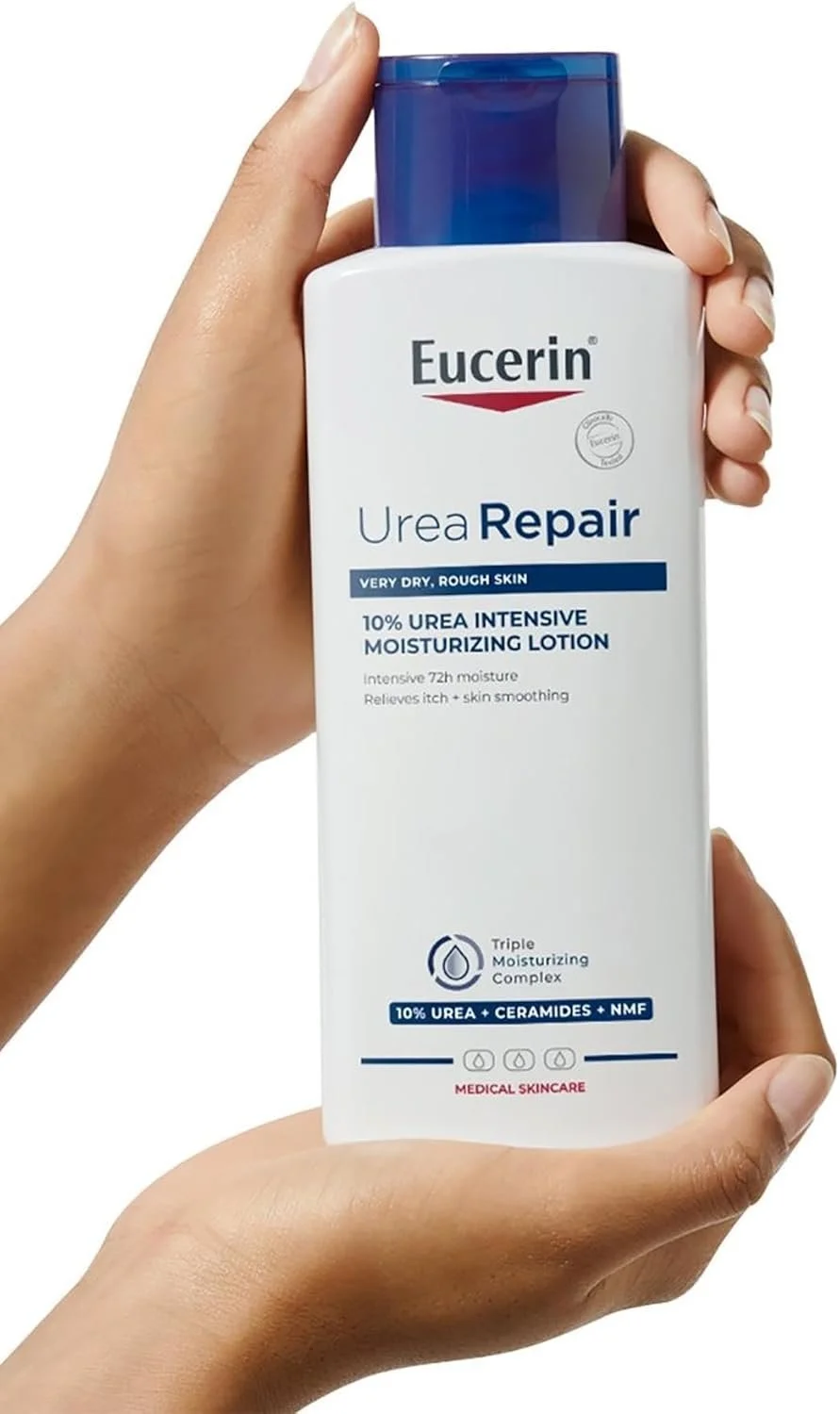
Eucerin UreaRepair Plus 10% Urea Body Lotion
a urea-based body lotion appropriate for consistently dry, rough leg skin. Keratolytic for scale reduction; humectant for deep moisture support. Apply generously after bathing within the two-to-three minute post-bath window.
When to seek GP assessment
For leg eczema, specifically seek GP assessment if:
The lower leg eczema is accompanied by swelling, brownish discolouration, varicose veins, or you have a history of deep vein thrombosis — this pattern suggests stasis dermatitis requiring venous assessment and compression.
Nummular eczema is not responding to mild OTC preparations — high-potency topical steroids are typically required and need prescription.
Persistent eczema-like changes on the lower legs that don't respond to emollient may be onychomycosis of the skin (tinea pedis spreading up the leg) — a GP can confirm with a skin scraping.
Supplement Support for Eczema-Prone Skin
The nutritional dimensions of leg eczema — vitamin D, zinc, omega-3, magnesium — are the same as for eczema at any location. The legs' natural dryness tendency makes consistent nutritional support for barrier function particularly relevant.
Drought's Skin Support Formula provides 14 nutrients including vitamin D, zinc, vitamin C, and magnesium — supporting the internal nutritional foundations of eczema management that are relevant regardless of location. Made in the UK, suitable for vegetarians, designed for consistent long-term daily use.
FAQ
What causes eczema on the legs?
Leg eczema may be influenced by:
Dry skin
Irritation
Environmental triggers
Skin barrier weakness
Lifestyle factors
Why do I have eczema behind my knees?
Behind the knees is the popliteal fossa — a classic atopic eczema site because of its flexural location (skin fold), sweating, and friction during movement.
What is stasis dermatitis and could I have it?
Stasis dermatitis is eczema caused by poor venous circulation, producing redness, itch, and brownish discolouration on the lower legs. If you have swelling, varicose veins, or brownish lower leg skin discolouration, seek GP assessment — compression therapy is required.
Is eczema on the shins the same as eczema elsewhere?
Shin eczema is often nummular (coin-shaped) and typically requires higher-potency topical steroids than atopic eczema elsewhere, as the skin responds less readily to mild preparations.
Why does eczema on my legs itch so much?
Dryness and inflammation can make eczema extremely itchy, especially when the skin barrier is damaged.
Can shaving make leg eczema worse?
Yes — blade friction and fragranced shaving products worsen barrier function. Use fragrance-free emollient as a shave lubricant and apply emollient immediately afterwards.
Is eczema on the legs common?
Yes — the legs are a very common area for eczema flare-ups.
What's the best moisturiser for leg eczema?
A rich, fragrance-free formulation — thick cream or ointment. Urea 10% body lotion addresses the rough, dry texture of chronic leg eczema specifically.
How can I calm eczema on my legs?
Many people focus on:
Moisturising consistently
Avoiding harsh skincare
Reducing irritation
Supporting the skin barrier
Managing triggers where possible
Final Thoughts
Leg eczema encompasses three distinct types: atopic eczema in the popliteal fossa (flexural distribution, same management as atopic eczema elsewhere), nummular eczema on the shins (coin-shaped patches requiring high-potency topical steroids), and stasis dermatitis on the lower legs (caused by venous hypertension, requiring compression therapy alongside emollient — not emollient alone). Identifying the type is the most important first step. Shaving over eczema-affected legs requires specific technique — fragrance-free lubricant, sharp razor, emollient immediately afterwards. Urea 10% body lotion addresses the specific dryness pattern of shin and leg skin effectively.
The Drought Skin Condition Support Supplement is designed to support eczema, psoriasis, and acne-prone skin from within as part of a broader long-term skin wellness routine.
Disclaimer: This article contains affiliate links. We earn a very small commission from each purchase made through these links. There is no additional cost to you. All products featured have been specifically selected as products we personally use and love. For further information, please see our disclaimer page.
-
Types of Eczema Explained: Causes, Symptoms & How Each Is Managed
Moisturising for Eczema: How to Do It Properly & What Actually Works
Eczema Clothing: What to Look for and What to Avoid
The Eczema Skincare Routine: Step-by-Step for Daily Management
Salicylic Acid for Eczema: When It Helps, When It Harms & What Works Better
