
How to Fake Tan Safely with Eczema or Psoriasis

There is no reason people with eczema or psoriasis can't use self-tanner — but it does require a different approach from people with uncompromised skin. Compromised skin barriers are more permeable (meaning ingredients penetrate more deeply), more reactive (meaning contact sensitisers cause stronger responses), and more likely to produce uneven results if not properly prepared.
With the right preparation, the right products, and a clear understanding of what to avoid, a natural-looking tan is achievable without triggering a flare.
Can you use fake tan with eczema or psoriasis?
Yes — fake tan is generally safer than sun exposure for eczema and psoriasis-prone skin, but it can still irritate sensitive skin if you're not careful, and the difference between a fake tan that works beautifully and one that triggers a flare often comes down to a single ingredient rather than the self-tanning process itself. The active compound in all self-tanners — DHA (dihydroxyacetone) — reacts with amino acids in the outermost skin cells to produce the characteristic brown colour, and DHA itself is generally well-tolerated on compromised skin. The problem is almost never the DHA; it's the fragrance, alcohol, and botanical extracts that surround it in most mainstream self-tanning formulations, any of which can trigger a contact allergen response on eczema or psoriasis-prone skin that is more permeable and more sensitisation-prone than healthy skin. For people with psoriasis specifically, there's an additional consideration around application technique that most fake tan guides don't address — one that's directly relevant to the Koebner phenomenon and determines whether the application process itself becomes a trigger for new plaque formation.
How fake tan actually works — and why some formulas are a problem
The active ingredient in all self-tanners is DHA (dihydroxyacetone) — a sugar that reacts with amino acids in the stratum corneum (the outermost layer of skin) through a process called the Maillard reaction, producing brown melanoidin pigments. This is the same chemical process responsible for browning food during cooking.
DHA itself is not an irritant for most people — it is considered safe and well-tolerated. The problem is what surrounds it in most tanning products:
Fragrance and parfum — the most common contact allergen in cosmetics. Found in the vast majority of mainstream self-tanners. Fragrance on compromised eczema or psoriasis skin penetrates more deeply and triggers reactions more readily than on intact skin.
Alcohol (denatured or isopropyl) — used in tanning mousses and sprays to create a lightweight texture. On eczema or psoriasis skin, it strips natural oils, increases transepidermal water loss, and leaves skin drier and more reactive.
Colour guides — added to some tanners to show where you've applied, these dyes can cause contact reactions in sensitive skin.
Preservatives — particularly MI/MCI, which are known contact sensitisers.
Finding a formula that provides DHA in a hydrating, fragrance-free, alcohol-minimal base is the primary selection task.
Products worth considering
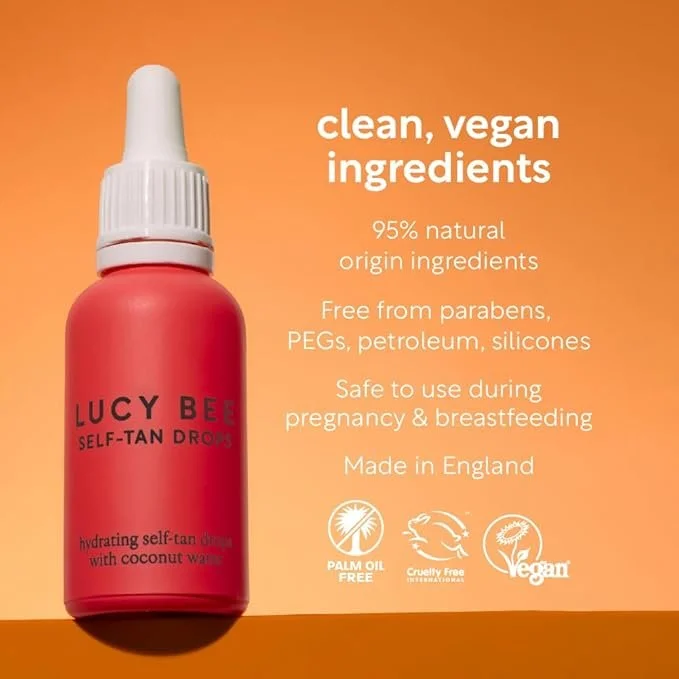
Lucy Bee Self-Tanning Drops
self-tan drops that mix directly into your existing emollient. This is one of the most practical options for eczema and psoriasis skin: you control the DHA concentration by how many drops you add, you're applying within a formula you already know your skin tolerates, and the emollient base means hydration is built into the application process. Fragrance-free and formulated without many of the common irritants in mainstream tanners.
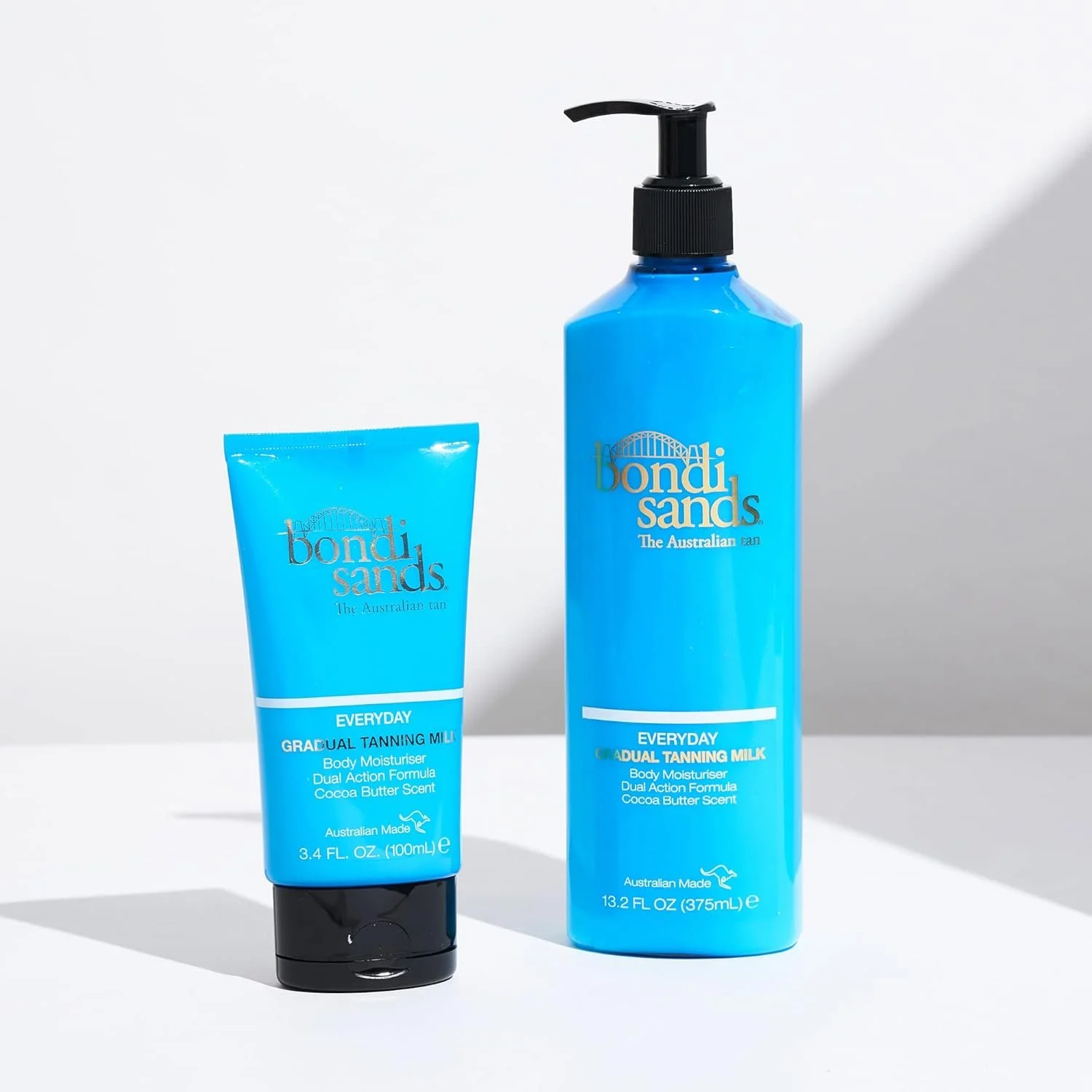
Bondi Sands Everyday Gradual Tanning Milk
a gradual, cumulative tanner that builds colour over several applications. Lower DHA concentration than immediate tanners means less risk of uneven development on textured skin, and the milk format is more hydrating than mousse. Apply daily after shower and moisturising until you reach the depth you want. Gradual tanners are generally the safest starting point for reactive skin.
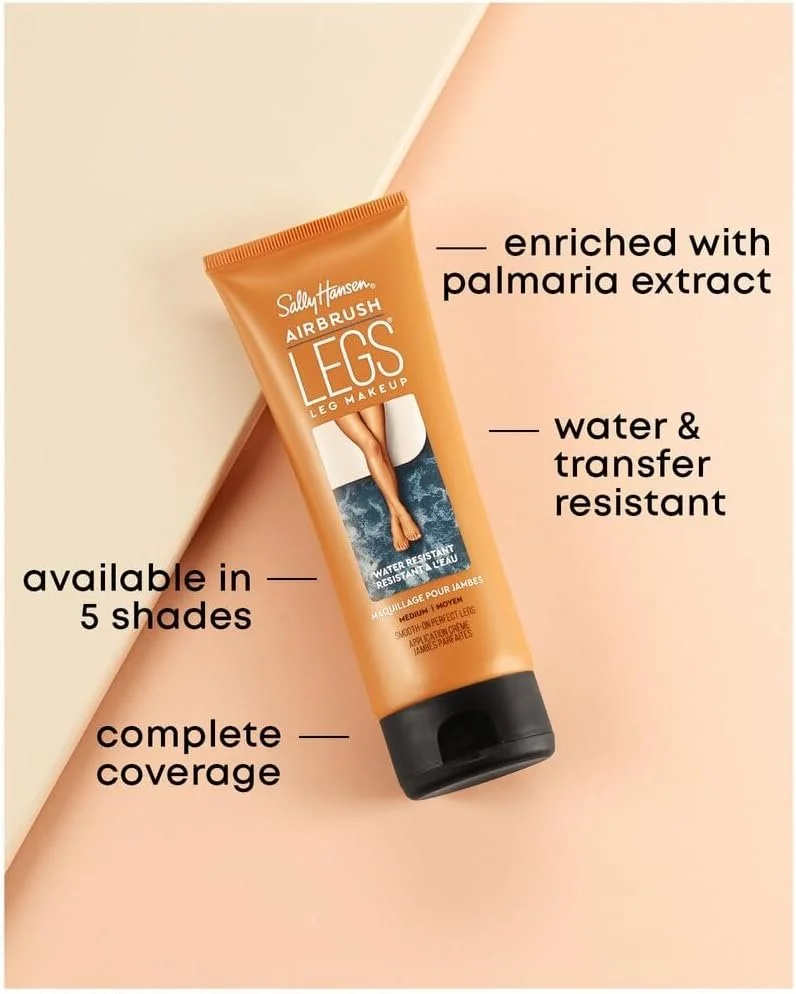
Sally Hansen Airbrush Legs
a tinted leg lotion that provides instant colour coverage rather than DHA-based tanning. This is a useful alternative for people who want to cover psoriasis plaques specifically — particularly on the legs — without using a DHA tanner at all. The coverage washes off with soap and water, making it low-commitment and easy to reverse.
Preparing skin for fake tan with eczema or psoriasis
Preparation matters more for eczema and psoriasis skin than for uncompromised skin — because the tan will develop differently on dry, scaly, or textured areas.
The evening before: apply a generous layer of emollient all over, including on any active dry patches or plaques. Well-hydrated skin develops tan more evenly. Avoid applying on broken or very inflamed skin — tan doesn't develop well there and may worsen irritation.
Exfoliation: gentle exfoliation helps remove dead skin buildup that would otherwise absorb excess DHA and develop darker patches. For eczema and psoriasis skin, physical scrubs are not appropriate — they cause friction damage and risk Koebner trauma on psoriasis. Instead, use a damp soft cloth or oatmeal-based cleanser to gently slough off loose surface cells. Do this 24 hours before tanning, not immediately before.
The barrier trick for plaques (psoriasis-specific): apply a thick layer of petroleum jelly or heavy emollient directly to any raised plaques before tanning. This creates a barrier that prevents the DHA from developing colour on the textured plaque surface, producing a more even overall result. The plaque area will remain lighter than the surrounding skin, but this is less visible than a darker ring of concentrated colour around unprotected plaques.
Patch test: 24 hours before full application, apply a small amount of the tanner to the inside of the elbow and check for any reaction. This is non-negotiable for reactive skin.
Application technique for sensitive skin
Apply emollient 10–15 minutes before tanning. This hydrates the skin and creates a light barrier. Allow it to absorb before applying the tanner — applying immediately over a thick emollient layer can dilute the DHA and reduce development.
Use a mitt throughout. Apply in long, smooth strokes rather than circular motions. Work in sections — legs, then body, then arms — to avoid streaking.
Be extra careful at joints and dry areas. Elbows, knees, ankles, and any dry patches absorb more DHA. Apply lightly here or apply a thin layer of emollient to these areas first to reduce absorption.
Avoid sensitive areas. Don't apply near the eyes, on actively inflamed patches, or on open or cracked skin.
Develop naturally. Allow the recommended development time without layering more product. More DHA doesn't mean a better result on compromised skin — it means more potential for irritation and patchiness.
Aftercare
Rinse with lukewarm water only after the development time — no soap or shower gel at this stage, as these strip the developing pigment.
Apply fragrance-free emollient immediately. This is the step most people skip and the one that makes the biggest difference to how long the tan lasts. Well-moisturised skin holds fake tan longer; dry, scaling skin sheds the stained cells faster.
Avoid hot baths, swimming, and heavy sweating for 24 hours after application — these accelerate fading.
Remove tan gently. When the tan fades, use a lukewarm bath and soft cloth rather than chemical removers, which are harsh on reactive skin. For gradual tanners, simply stopping application will allow the tan to fade naturally over several days.
Reapply no more than once a week. Frequent application on reactive skin increases cumulative irritant exposure. Once weekly maintenance application on well-hydrated skin is a practical rhythm.

When to wait
Do not apply fake tan if skin is actively flaring — inflamed, weeping, or significantly broken. Fake tan on this skin will be uncomfortable, will develop unevenly, and may worsen the flare. Wait until the skin has calmed before tanning, and maintain barrier support in the weeks leading up to application so the skin is in its best possible condition.
Skin support for eczema & psoriasis-prone skin
Consistently well-maintained skin holds fake tan better, develops more evenly, and is less likely to react. The internal nutritional foundations of barrier function — zinc, vitamin D, vitamin C, biotin, and magnesium — determine how resilient the skin barrier is on any given day.
Drought's Skin Support Formulaprovides 14 nutrients selected for their roles in skin barrier function and immune regulation — supporting the skin from within so that external preparations, including self-tanner, have the best possible surface to work with. Made in the UK, suitable for vegetarians, designed for consistent long-term daily use.
FAQs: Fake tan & sensitive skin
Is fake tan safer than sun exposure for eczema and psoriasis?
Yes — DHA (dihydroxyacetone) reacts with proteins in the outermost skin layer to create colour without UV radiation. UV exposure is a documented Koebner trigger for psoriasis and a barrier stressor for eczema-prone skin. Fake tan removes the UV risk entirely — the remaining concerns are the fragrance, alcohol, and preservatives in the formulation rather than the tanning mechanism itself.
Can fake tan make eczema worse?
Yes — but the trigger is almost always the surrounding formulation rather than DHA itself. Fragrance compounds (particularly linalool and limonene) are the most common contact allergens; alcohol dehydrates and disrupts the ceramide-rich lipid layer eczema skin is already short of; preservatives including methylisothiazolinone are documented sensitisers. Choosing fragrance-free, alcohol-free, hydrating formulations eliminates most of the risk. Apply only on settled, non-inflamed skin — never during active flares.
Why does fake tan look patchy on psoriasis?
Psoriatic plaques have a significantly thicker, more adherent stratum corneum than surrounding skin — they absorb DHA at a different rate and produce darker, more pigmented patches. Applying a thick emollient specifically to plaque edges before tanning creates a barrier that reduces the absorption differential. Gradual tanners with lower DHA concentrations produce more even results on psoriatic skin than high-concentration mousses.
Does DHA worsen psoriasis?
No published evidence shows DHA itself triggers psoriasis flares or worsens inflammatory activity. The problematic components are the alcohol, fragrance, and preservative systems that accompany DHA in most commercial formulations. A fragrance-free, alcohol-free DHA formulation — or tanning drops mixed into your regular emollient — carries significantly lower flare risk than standard commercial tanners.
Can I apply fake tan over topical steroids or calcineurin inhibitors?
Wait at least 24 hours after applying any topical treatment before tanning over the same area. Topical steroids temporarily thin the skin barrier in treated areas — applying DHA immediately after increases penetration and absorption unevenly. Tacrolimus and pimecrolimus (calcineurin inhibitors) specifically increase photosensitivity — less relevant for DHA tanning but worth noting if any UV exposure is anticipated alongside tanning product use.
Which fake tan formats are safest for eczema and psoriasis?
Tanning drops mixed into your regular fragrance-free emollient are the safest format — they dilute DHA to a controlled concentration, eliminate the need for additional formulation ingredients, and allow precise application to specific areas. Gradual tanning lotions with hydrating bases (aloe vera, glycerin, shea butter) are the next best option. Avoid aerosol sprays (airborne DHA and propellant particles irritate airways and deposit unevenly on sensitive skin) and wipe-off formulations (mechanical trauma on removal).
How often can I fake tan with eczema or psoriasis?
Once a week maximum — and only when skin is consistently settled between applications. More frequent application compounds formulation ingredient exposure and doesn't allow full fading between sessions, which leads to uneven build-up on texture-compromised skin. If skin is reacting between sessions — new redness, itch, or dryness in tanned areas — extend the interval and reassess the formulation rather than continuing on the same schedule.
Summary
Fake tanning with eczema or psoriasis is achievable — and for many people with visible skin conditions, a natural-looking tan provides confidence that sunbathing cannot safely provide. The keys are fragrance-free, hydrating formulas (gradual tanners and drops mixed into emollient being the most forgiving options), thorough preparation the night before, the barrier emollient technique on psoriasis plaques, and generous aftercare moisturising. Never apply during an active flare, always patch test, and use a mitt for even application. The tan itself is the easy part — it's the preparation that determines the result.
Written by the Drought Skin team — specialists in natural support for psoriasis and eczema.
Disclaimer: This article contains affiliate links. We earn a very small commission from each purchase made through these links. There is no additional cost to you. All products featured have been specifically selected as products we personally use and love. For further information, please see our disclaimer page.
-
Best Sunscreen for Eczema: What to Use, What to Avoid & How to Apply
At-Home Face Masks for Eczema-Prone Skin
Psoriasis Skincare Routine: What Actually Helps, What to Avoid & Common Mistakes
Moisturising for Eczema: How to Do It Properly & What Actually Works
Psoriasis & Eczema Triggers: What Causes Flare-Ups & How to Identify Yours
