
Menopause & Eczema: Why It Happens + What Helps

For many women, the skin changes that come with menopause arrive without warning. You may have had eczema as a child that disappeared for decades — and then found it returning in your late 40s or 50s. Or you may never have had eczema before, only to find your skin suddenly dry, itchy, and reactive in ways you don't recognise.
Neither scenario is unusual. The hormonal shifts of menopause have a profound effect on skin — and eczema is one of the more common, and least talked about, consequences.
This article explains why it happens, what's going on beneath the surface, and what the most effective approaches to managing it look like.
Can menopause cause eczema?
Menopause doesn't directly cause eczema — but it can trigger or worsen it through hormonal changes that are more specific and more mechanistically interesting than the generic "hormones affect skin" framing suggests. Oestrogen plays specific roles in ceramide synthesis, filaggrin expression, and immune regulation that are directly relevant to eczema biology — meaning its decline during perimenopause and menopause doesn't just produce dryness, it removes several simultaneous layers of barrier and immune protection that eczema-prone skin depends on. For many women, this explains why eczema that was well-controlled for years suddenly becomes harder to manage in their 40s or 50s, or why eczema appears for the first time at a stage of life when they assumed they'd grown out of any skin sensitivity they'd had.
It often starts in perimenopause — not menopause itself
This is worth clarifying because many women are caught off guard by skin changes that begin years before they'd consider themselves menopausal.
Perimenopause — the transition period leading up to menopause — can begin in the early to mid-40s, sometimes earlier. During this phase, oestrogen levels don't simply decline steadily; they fluctuate unpredictably. Some months they're relatively normal, others they drop sharply. It's these fluctuations, as much as the eventual decline, that affect skin.
Menopause itself is defined as twelve consecutive months without a menstrual period. The average age in the UK is 51, but the skin changes associated with falling oestrogen often begin several years before this point.
If your skin has become noticeably drier, more sensitive, or prone to itching or flaring in your 40s — even if your periods are still regular — hormonal changes may well be a factor.
What oestrogen does for your skin
To understand why its decline matters, it helps to understand what oestrogen actually does for skin health.
Oestrogen plays several important roles in maintaining healthy skin. It stimulates the production of collagen and elastin, the proteins that give skin its structure and elasticity. It supports the production of natural oils (sebum) that keep skin lubricated. It helps regulate the skin's water-binding capacity — its ability to hold onto moisture. And it has a role in maintaining the balance of the skin microbiome, the community of micro-organisms that live on the skin's surface and contribute to barrier function.
When oestrogen levels fall, all of these systems are affected simultaneously. The skin produces less oil, retains less moisture, loses structural protein more rapidly, and becomes more permeable — meaning irritants and allergens can penetrate more easily.
This is the biological mechanism behind the dryness, thinning, sensitivity, and increased reactivity that many women experience during the menopause transition. It also explains why eczema — a condition rooted in a compromised skin barrier and excessive immune reactivity — tends to emerge or worsen during this period.
Why menopause affects your skin
During menopause, levels of oestrogen drop significantly—and this has a major impact on your skin.
This can lead to:
reduced oil production
increased water loss
weaker skin barrier
As a result, skin becomes drier, thinner, and more sensitive, which can trigger eczema symptoms
Why eczema often gets worse during menopause
If you already have eczema, menopause can make it worse.
This happens because:
Increased dryness
Lower oestrogen means skin struggles to retain moisture. A healthy skin barrier regulates how much water evaporates from the skin's surface. With oestrogen decline, this regulation becomes less effective. The result is skin that feels persistently dry and tight, even with regular moisturising — because moisture is being lost from within, not just from the surface.
Weakened skin barrier
The skin barrier is partly made up of lipids — fats that fill the spaces between skin cells and prevent unwanted substances from passing through. Oestrogen supports healthy lipid production. As levels fall, the barrier becomes more porous, which means irritants, bacteria, and allergens that would normally be repelled start getting through. This is a direct trigger for the immune response that drives eczema inflammation.
Increased sensitivity
Skin reacts more easily to products and environmental triggers.
Heightened immune reactivity
Oestrogen has a modulating effect on immune function — it helps regulate the immune responses that, when overactive, produce the inflammation of eczema. Its decline can tip the balance toward greater immune reactivity, making the skin more prone to flaring in response to triggers that would previously have been tolerated.
Slower skin renewal
Skin cells regenerate more slowly as oestrogen falls. This means the skin takes longer to recover from irritation, damage, or a flare-up — which is why menopausal eczema often feels more persistent and harder to shift than it did earlier in life.
The stress and sleep connection
Menopause frequently disrupts sleep — night sweats, insomnia, and anxiety are common symptoms. Poor sleep and chronic stress are both well-established eczema triggers, as they elevate cortisol, which in turn promotes inflammatory responses in the skin. This creates a compounding effect: the hormonal changes cause skin problems, the skin problems disrupt sleep, poor sleep worsens inflammation, and the cycle continues.
Hormonal fluctuations
These can trigger inflammation and flare-ups.
Many women notice eczema returning after years of being under control
Common menopause-related eczema symptoms
Not all skin changes during midlife are related to menopause — but the following patterns are particularly associated with hormonal skin changes:
Eczema returning after years of being well-controlled or absent. New areas of sensitivity on the face, neck, or chest that weren't previously affected. Skin that feels persistently dry despite regular moisturising. Increased reactivity to products that were previously well-tolerated. Flare-ups that seem to correlate with hot flushes or periods of stress and disrupted sleep. Skin that feels thinner or more fragile than it used to.
If several of these resonate, it's worth discussing the hormonal dimension with your GP — particularly if your skin changes began in your 40s alongside other perimenopausal symptoms.
Typical symptoms include:
dry, flaky skin
itching or irritation
redness or inflammation
increased sensitivity
flare-ups in previously unaffected areas
Symptoms often feel more persistent and harder to manage.
Other menopause symptoms that can worsen eczema
Menopause doesn’t happen in isolation—other symptoms can make eczema worse:
hot flushes (increase irritation)
sweating (can trigger itching)
stress and poor sleep
These all contribute to flare-ups
Why menopause eczema can feel different
This is where many people get confused.
Menopausal eczema often feels:
drier than usual
more sensitive
slower to heal
This is because skin also loses collagen and elasticity during menopause
How to manage eczema during menopause
Treatment focuses on hydration, barrier repair, and trigger management.
1. Prioritise moisturising
the principles of moisturising for eczema apply here, but with greater urgency
fragrance-free is non-negotiable. Skin that is already hormonally sensitised is far more prone to reacting to fragrance ingredients, even ones it previously tolerated.
apply regularly throughout the day
during menopause, the skin's reduced capacity for moisture retention means that emollients need to work harder and be reapplied more frequently.
applying within two to three minutes of bathing — while the skin is still slightly damp — is particularly important, as is reapplying throughout the day rather than once in the morning and hoping for the best.
thick creams and ointments are generally more effective than lighter lotions for menopausal skin
This is the most important step.
2. Switch to gentle skincare
this is a period when it's worth reviewing everything that comes into contact with your skin — not just your dedicated skincare products. Soap, shower gel, laundry detergent, fabric conditioner, and even the water temperature you wash in all become more significant when the skin barrier is compromised.
use non-irritating products
wash in warm rather than hot water — hot water accelerates transepidermal water loss and strips what little natural oil the skin is producing
switch to a soap-free wash or emollient wash product
consider fragrance-free laundry products, particularly for bedding and nightwear that's in contact with skin for hours at a time.
3. Manage heat and sweat
hot flushes present a particular challenge for eczema-prone skin. The sudden temperature increase causes sweating, and sweat — particularly in skin folds and areas of active eczema — is a direct irritant
some practical measures that help: keeping the bedroom cool at night, wearing natural fibres (cotton and bamboo are better than synthetic fabrics), using a cooling spray on particularly difficult nights, and having an emollient to reapply after a flush has subsided.
4. Manage stress and sleep
stress is a major trigger
given the compounding relationship between poor sleep, elevated cortisol, and eczema flare-ups, anything that improves sleep quality during menopause is likely to have a downstream benefit for skin
address night sweats (which is often a conversation worth having with your GP about HRT or non-hormonal options)
relaxation techniques can help
establish a consistent sleep environment
5. Medical treatments (if needed)
topical steroids
prescription creams
6. Hormone replacement therapy (HRT)
for some women, HRT addresses the root cause of menopause-related skin changes more directly than any topical intervention.
by restoring oestrogen levels, HRT can improve skin hydration, thickness, and barrier function — and in doing so, may reduce eczema severity.
the decision about HRT is a personal one involving a broader assessment of risks and benefits, and it's a conversation to have with your GP or a menopause specialist rather than something to self-manage.
it's worth raising the skin angle explicitly in that conversation — particularly if skin changes are significantly affecting your quality of life — because dermatological benefits are a legitimate consideration.
Skin support for eczema-prone skin
One dimension of menopausal skin management that is often overlooked is nutrition. The skin's needs change during this period, and several nutrients play specific roles in supporting the systems that oestrogen decline compromises.
Vitamin C is essential for collagen synthesis — and collagen production, already falling with age, accelerates its decline as oestrogen drops. Zinc supports skin barrier function and immune regulation. Vitamin D has roles in both immune modulation and skin barrier maintenance. Biotin contributes to normal skin condition. Magnesium supports stress regulation and sleep quality — both relevant for the reasons discussed above.
Ensuring adequate levels of these nutrients through diet or supplementation won't replace oestrogen, but it does give the skin better raw materials to work with under more difficult hormonal conditions.
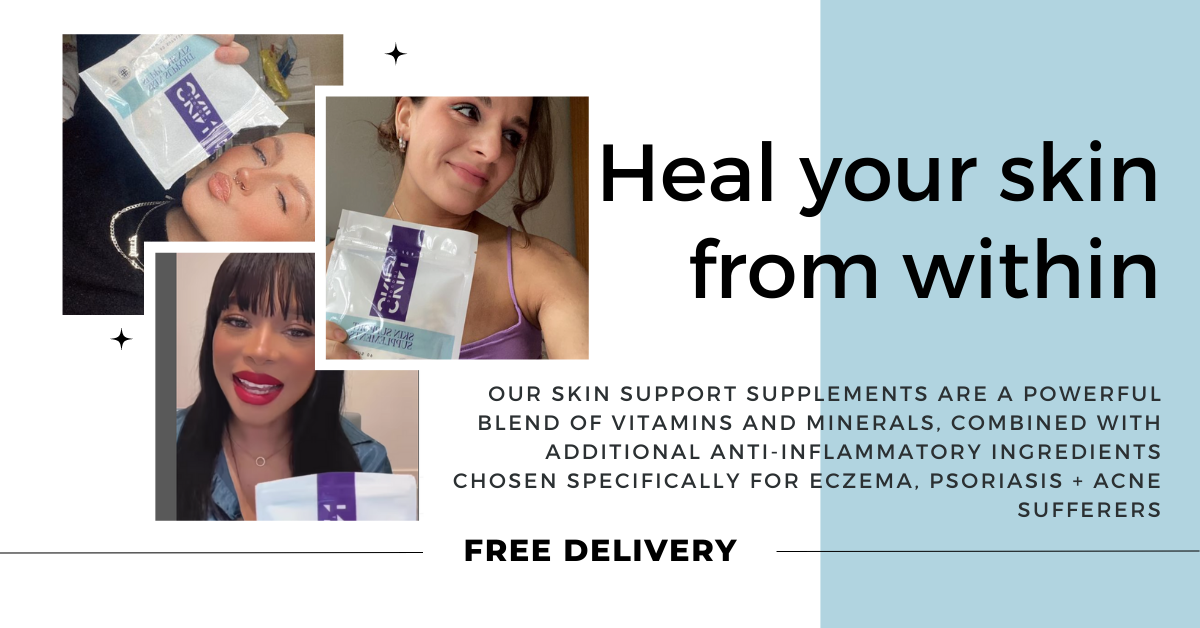
Drought's Skin Support Formula brings these nutrients together in a daily supplement designed specifically for people with reactive, dry, or sensitive skin. It contains zinc, vitamin C, vitamin D, biotin, magnesium, B vitamins, CoQ10, and more — 14 nutrients in total, each included for its documented role in skin health. Made in the UK, suitable for vegetarians, and designed for consistent long-term use.
For women navigating menopause-related skin changes, it's a straightforward way to ensure the nutritional foundations are covered while managing other aspects of the transition.
When to see your GP
Most menopause-related skin changes can be managed with the approaches above, but there are situations where it's worth seeking medical advice sooner rather than later:
If your eczema is severe, affecting sleep significantly, or not responding to standard emollient use. If you suspect your skin changes are related to perimenopause or menopause and you haven't yet discussed this with your GP. If you're interested in HRT and want to understand whether it might help your skin alongside other symptoms. If you develop signs of infection in eczema-affected skin (increased warmth, weeping, crusting, or flu-like symptoms) — this requires prompt treatment.
FAQs: Menopause and eczema
Can menopause trigger eczema?
Yes — hormonal changes can trigger or worsen symptoms. Menopause doesn't cause eczema in the way a virus causes an infection. But the hormonal changes of menopause — particularly the fall in oestrogen — significantly affect skin barrier function, hydration, and immune reactivity in ways that can trigger eczema for the first time or cause existing eczema to worsen considerably.
Why is my eczema worse in my 40s or 50s?
Perimenopause often begins in the early to mid-40s, sometimes before periods become noticeably irregular. Fluctuating and then falling oestrogen affects the skin's ability to retain moisture and maintain its barrier — which can wake up dormant eczema or make existing symptoms much harder to manage.
Will eczema go away after menopause?
For some women, skin does settle once hormone levels stabilise at their new lower baseline. For others, the changes to barrier function and immune reactivity persist and require ongoing management. There is no reliable way to predict which pattern will apply to any individual.
Does HRT help eczema?
It can. HRT restores oestrogen levels and has been shown to improve skin hydration, thickness, and barrier integrity — all of which are relevant to eczema. Whether the benefit is significant enough to influence your HRT decision is something to discuss with your GP alongside the broader considerations.
What is the best moisturiser for menopausal eczema?
Rich, fragrance-free emollients and ointments are generally more effective than lighter lotions for skin affected by both eczema and oestrogen decline. Products containing ceramides, glycerin, or colloidal oatmeal are well-suited to compromised skin. Apply frequently — particularly after bathing.
Can supplements help with menopause-related eczema?
Targeted nutritional supplementation can support the skin systems that oestrogen decline compromises — including collagen production, barrier function, and immune regulation. It won't replace oestrogen, but it does give the skin better nutritional support during a difficult period.
Summary
Menopause worsens eczema through oestrogen's specific roles in ceramide synthesis, filaggrin expression, and immune regulation — not through a single dramatic change but through a gradual withdrawal of several simultaneous protective effects. Perimenopause often precedes the most obvious hormonal changes by years, making the skin connection easy to miss. Richer emollients, fragrance elimination, stress management, sleep quality, and targeted nutritional support address the practical dimensions; HRT is worth discussing with a GP for women where skin changes are significant alongside other menopause symptoms. The goal is building the strongest possible barrier foundation for a skin type that is going through one of its most demanding transitions.
In short:
Hormone changes can trigger flare-ups
Dryness and sensitivity increase
Existing eczema may return or worsen
Not caused by menopause alone
Menopause can have a significant impact on your skin, especially if you’re prone to eczema. While topical care helps manage symptoms, it’s often not enough on its own.
Supporting your skin from within can help reduce flare-ups and improve long-term resilience.
Start your skin support journey →
Written by the Drought Skin team — specialists in natural support for psoriasis, eczema and acne
Disclaimer: This article contains affiliate links. We earn a very small commission from each purchase made through these links. There is no additional cost to you. All products featured have been specifically selected as products we personally use and love. For further information, please see our disclaimer page.
